
David E. Wallace & Company, LLC, Gorham, Maine
Saint Rose of Lima Catholic Church, Jay, Maine
It is always an exciting moment when the music director of a parish church contacts our shop in search of a pipe organ for their worship space. Whether it is for a new organ or the restoration of an existing instrument, it is an opportunity to be creative and discover what will work best to fill the musical needs of the church. Such was the case with Saint Rose of Lima Catholic Church in Jay, Maine. The church building dates from the 1950s and was not designed to house a pipe organ, a situation that offered many challenges to the process of acquiring one.
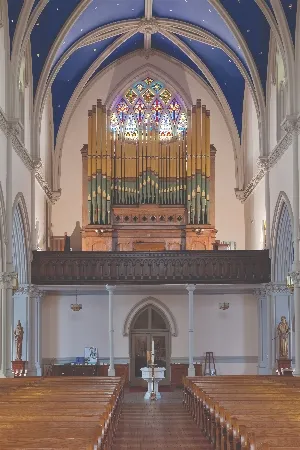
It was decided that the 1868 Lathrop Tilton organ in storage at Wallace & Co. had the most potential for the gallery at Saint Rose. With minor alterations, the organ would fit in the shallow rear gallery and sit just under a low hanging structural beam. The one-manual organ, which was originally built in the neighboring town of East Livermore, was determined to have pipework of the correct scale and character to be appropriate for the Saint Rose nave.
Lathrop C. Tilton was a Maine-based organ builder born in 1830 in Livermore. It is not known where he got his training as an organ builder, though local newspapers noted that he provided wooden organ pipes to other builders. His shop was located in East Livermore when his four known pipe organs were built.
Given that the 1868 organ is one of three Tilton organs remaining, we wanted to be sensitive to its unique historical context. However, if the organ was to be rescued from eternal storage and to be used regularly in a church setting, some changes to its playability were absolutely necessary.
Though the pipes were in rough condition due to decades of improper maintenance, it was determined that it would be possible to successfully restore them. Two tonal changes were planned in order to assure the success of the organ. To make the best use of space, the 2′ Fifteenth would become a double-draw stop. When the stop is drawn half way, the Fifteenth will play. When drawn fully, a quint rank is added to the Fifteenth. The quint starts at 2⁄3′ pitch, breaks to 1-1⁄3′ at C13, and breaks to 2-2⁄3′ at G32, continuing to G56. A third rank at 4′ pitch is also added on the second draw and runs from G44 to G56, making a two- to three-rank Mixture. The second change was to replace the unusable original Pedal 16′ Subbass with a new set of pipes.
The placement of the organ against a wall necessitated constructing a new expression box with roof-top access and a walkboard above the manual chest for tuning. The striking solid walnut Romanesque casework is a prime example of mid-nineteenth-century craftsmanship. To accommodate the narrow depth of the gallery, the Pedal was divided on each side of the organ. New casework matching the original was constructed to house the new Pedal windchests and action.
The structurally insufficient original framework of the organ was reengineered to improve both stability and ease of access for maintenance. The key action for both manual and pedal was redesigned to allow for better feel and easy adjustment. The original wind system had suffered from poor quality lumber and a botched releathering effort in the 1970s. A new double-rise reservoir was constructed that includes the original feeder bellows, allowing the organ to be manually powered.
David E. Wallace & Company is delighted that Saint Rose of Lima parish chose the Lathrop Tilton organ to provide the musical support for Mass and other activities. The restored Tilton pipework, now controlled by a refined and sensitive touch, features a bright and bold principal chorus topped by the new mixture. The organ sports a wide dynamic range with four 8′ voices that are all under expression. We can now play and hear an instrument that depicts the sounds of organ building practices in Maine during the 1860s.
The renovation project team included Nick Wallace, Rebecca Schnell, Gwen Rowland, and David Wallace.
—Nick Wallace
All photos credit Nick Wallace
Manual (56 notes, enclosed)
8′ Open Diapason
8′ Dulciana Treble (TG)
8′ Dulciana Bass (1–19)
8′ Keraulophon
8′ Clarabella (TG)
8′ Stopped Diapason Bass (1–19)
4′ Principal
4′ Flute
2′ Fifteenth/II–III Mixture (double draw)
Pedal (30 notes)
16′ Bourdon
One manual, nine stops, ten ranks, 488 pipes
Builder’s website: wallacepipeorgans.com.
Church website: stroseandstjosephmaine.org.
Related Articles